The Problem with AI Writers (And How to Fix It)
Most people use AI wrong. They ask it to write — and get competent but forgettable content in return. The real problem isn't AI. It's how we're using it. Here's the simple shift that transforms AI from a crutch into a thinking partner.
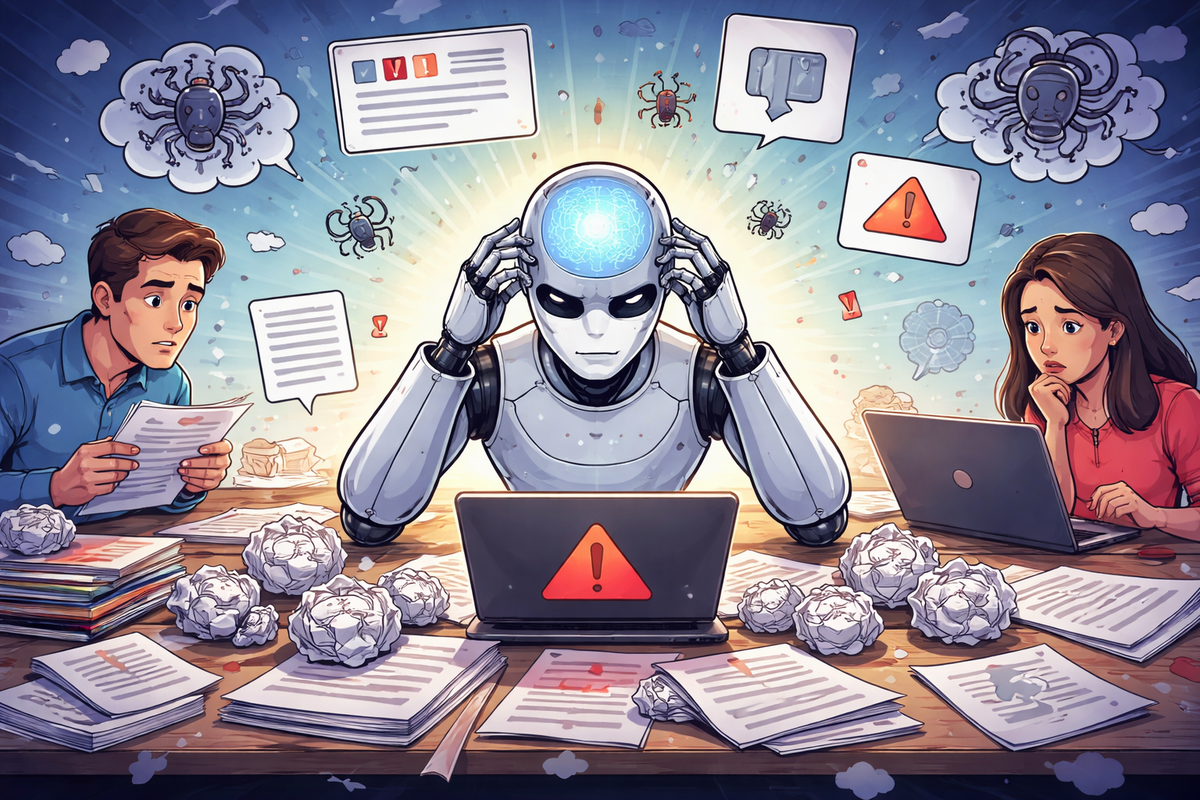
I've been there.
You open a new document, stare at the blank page for twenty minutes, then give up and ask ChatGPT to "write a blog post about productivity." Thirty seconds later, you have 800 words. You paste it in. It sounds... fine. Technically correct. Utterly forgettable.
You publish it anyway. It gets twelve views. You wonder why you bothered.
This is the AI writing trap. And almost everyone falls into it.
The Real Problem Isn't AI — It's How We're Using It
Here's the thing nobody talks about: AI doesn't make you write worse. It makes you write lazy.
Before AI, if you wanted to write something, you had to actually think. You'd sit with an idea, turn it over, argue with yourself about the best angle. That struggle? That was part of the process. That was where your voice lived.
Now? You just ask AI. And AI gives you something competent but soulless. The shortcut became the whole path.
The result is a sea of identical content. Every AI-assisted post has the same structure, the same transitions ("Furthermore," "In conclusion," "It's worth noting that"), the same blah-blah-blah that says nothing. Readers can smell it now. They've trained themselves to skim past the robotic stuff.
That's the problem. Not that AI is bad — but that we've let it replace thinking instead of augmenting it.
What Actually Happens When You Rely on AI to Write
Let me be specific. When I started using AI to "help" with my writing, three things went wrong:
One: My ideas got smaller. Instead of wrestling with a complex thought, I'd just ask AI to "simplify it." Instead of finding my own angle, I'd let AI pick one. My posts stopped being interesting because I stopped doing the hard intellectual work.
Two: My voice disappeared. AI doesn't have a voice — it has a pattern. The more I leaned on it, the more my writing started sounding like everyone else's. Generic. Safe. Forgettable. I'd read back old posts I'd written before AI and think, "Wow, I used to be more interesting than this."
Three: I stopped trusting my own work. Every time AI "polished" something I wrote, I'd second-guess myself. Was my original version better? Was AI's version better? I'd spend more time editing than writing. The whole thing became a time sink with no upside.
Sound familiar?
The Fix: Use AI as a Sounding Board, Not a Ghostwriter
Here's what changed everything for me: I stopped asking AI to write.
Instead, I started asking it to talk.
Instead of: "Write a blog post about productivity."
I say: "I'm stuck on an argument about productivity. Here's what I think so far: [my thoughts]. What am I missing? What would a skeptical reader push back on?"
That one shift changes everything. Now AI is a thinking partner — someone to argue with, to challenge my assumptions, to offer a perspective I hadn't considered. The idea is still mine. The angle is still mine. AI just helps me stress-test it.
Instead of: "Write an intro for this post."
I say: "Here's my rough intro: [my version]. What's weak about it? How could it be more compelling?"
Now I'm using AI as an editor, not a writer. It points out problems, I fix them. The final product still sounds like me — because it is me, just sharper.
Instead of: "Give me five headline options."
I say: "Here are my three headline ideas: [list]. Which one is strongest and why? What words in each one are working hardest?"
Again, I'm getting analytical help, not content generation. My ideas, AI's critique. That's the combination that works.
Three Rules That Actually Help
If you take nothing else from this post, remember these three:
Rule 1: Write the first draft yourself.
Raw, messy, full of typos. It doesn't matter. Write it yourself. This is where your voice lives. AI can help you later, but the first draft must be yours.
Rule 2: Use AI to find the holes, not fill them.
After your draft, ask AI: "What's unclear here? What would a reader push back on? What's missing?" Then use your own brain to fix those gaps.
Rule 3: Edit like a human, not like a spell-checker.
Read your final draft out loud. Does it sound like you? Does it sound like a real person talking, not a corporate memo? If it sounds robotic, it needs more of you in it — not less.
The Underlying Principle
Here's the thing: AI can help you write more. It can help you write faster. But it cannot — cannot — give you something worth reading.
Only you can do that. Your specific experience. Your specific take. Your willingness to say something real and put your name on it.
AI is a tool. Like any tool, it works best when you understand what it's actually good at. A hammer is great for nails, terrible for screws. AI is great for brainstorming and editing, terrible for thinking and feeling.
Know the difference. Use it accordingly.
The Bottom Line
The problem with AI writers isn't that they're AI. It's that we've been using them to avoid the work that makes writing worth reading.
Don't use AI to skip the hard parts. Use it to get better at the hard parts.
Write the messy first draft yourself. Argue with AI about your ideas. Edit until it sounds like you. That's the system. That's how you make AI work *for* your writing instead of against it.
Now go write something real.
If you found this useful, subscribe to get weekly posts on building a better writing workflow — with AI, but on your terms.