I Tried to Build a Second Brain for 2 Years. Here's What Actually Works
Most second brain advice is backwards — don't build the system first. Here's what actually works, after two years of trial and error.
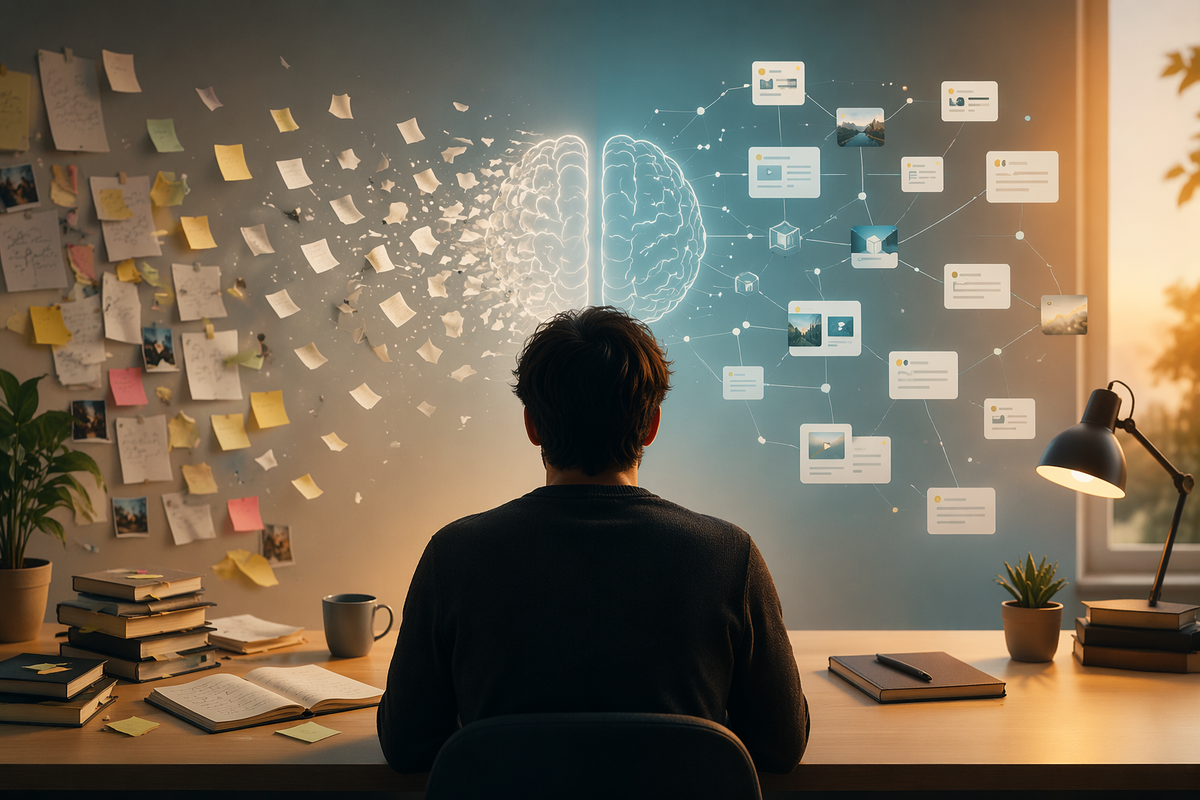
Two years ago, I discovered the concept of a "second brain" and got excited.
I downloaded Obsidian. Watched YouTube videos about Zettelkasten. Created folders with names like "Cards" and "MOCs." Set up daily note templates. Read about bi-directional links.
Six months later, I had a beautiful, empty vault.
The system was there. The knowledge wasn't. I'd built the infrastructure for ideas I didn't have yet.
This is the mistake most people make when they try to build a second brain. They build the architecture before they have anything to put in it. And they abandon it six weeks later when it feels like more work than value.
I'm not here to tell you the perfect note-taking app. I'm here to tell you what I actually use — after two years of trial, error, and one very messy vault that taught me everything.
The Problem With "Building a System"
Most second brain advice starts with the system.
It says: "Start with structure! Create your folders! Design your tagging taxonomy!"
This is backwards.
You don't design a filing cabinet and then go find things to put in it. You find things worth keeping, and the structure emerges from what you actually collect.
My vault today looks nothing like what I planned two years ago. The folders I thought I'd use are empty. The folders I actually use didn't exist until six months in.
So start with one rule: capture first, organize later.
The Capture Habit That Changed Everything
Here's the only daily habit I actually kept:
Every time I learn something useful, I write it down. Not in a particular app. Not in a particular format. Just somewhere I can find it later.
A voice memo on my walk. A text note on the bus. A sentence in my phone's notes app at 11pm.
The format doesn't matter. The habit does.
I use Obsidian now, but I built that habit first — years before I switched apps. I used Apple Notes for a year. I used Google Docs before that. The tool is irrelevant. The habit is everything.
Here's what I capture:
- Questions I can't answer yet. Things I'm wondering about. Things I want to research.
- Surprises. Things that contradicted what I expected. "I thought X but actually Y."
- Patterns. Things I notice repeatedly. "This keeps coming up in my conversations."-
- Quotable moments. Sentences that hit me hard. Books. Podcasts. People I admire.
That's it. Not grand insights. Not polished notes. Just raw material.
How I Actually Use My Notes (The 3-Month Rule)
Here's the question I get most: "But how do you actually turn notes into content?"
The honest answer: I don't use most of my notes.
This sounds like failure. It's actually the point.
My notes aren't an archive. They're a filter. Most things I capture, I use once — in a conversation, a decision, a piece of writing — and never look at again.
The notes that matter are the ones I return to after three months.
Here's why that works: You can't know what's valuable when you're in the moment. A thought that felt important in January might be obvious by April. Or it might have grown into something I now see as central to how I think.
Three months later, I read my notes with fresh eyes. The ones that still spark something — those go into my writing queue. The ones that feel dated or obvious — I delete them without guilt.
This is the real function of a second brain: not storage, but selection. Over time, the notes that survive become a record of what you actually think about.
The Simple Structure That Finally Worked
For the first year, I tried complex structures. Tags, nested folders, linked notes. None of it stuck.
Here's what I use now — and what I've kept for eight months without abandoning:
One folder for "Inbox." Everything goes here first. No organisation, no sorting, no tagging. Just a place where new notes live until I process them.
One folder for "Written." When I use a note in a piece of content — a blog post, a thread, an email — I move it here. Not for archival purposes. For tracking what I've actually used.
That's it.
I know people who have 47 tags and 12 nested folders and swear by their system. That's great for them. For me, complexity was a trap. I spent more time organizing than thinking.
The structure is minimal because the work is in the capturing, not the filing.
The One System Worth Copying
If I had to keep only one thing from two years of experiment, it would be this: a list of recurring questions I revisit regularly.
Not a to-do list. Not goals. Questions.
For example:
- What am I trying to figure out right now?
- What keeps surprising me this month?
- What do I believe that I believed differently a year ago?
These aren't in my notes app. They're in a sticky note on my desk.
Every Friday, before I write, I look at these questions. Sometimes they connect to something I captured that week. Sometimes they connect to something I captured six months ago. Sometimes they connect to nothing, and I move on.
But the questions keep my thinking alive. They keep my notes from becoming a museum of my past self.
The second brain isn't a database. It's a conversation with yourself, over time.
Start With This
You don't need Obsidian. You don't need Zettelkasten. You don't need to watch 20 YouTube videos about PKM systems.
Start with this:
- Open your phone's notes app.
- Write one thing you learned today.
- Set a reminder to do it again tomorrow.
That's it. That's the whole system.
If you do that for 30 days and actually stick to it, come back and we'll talk about what comes next. But most people won't. Most people will watch videos about building systems instead of actually building the one habit that makes systems work.
The second brain is a side effect. The habit comes first.